

The Man Jesus: Jesus Our Example
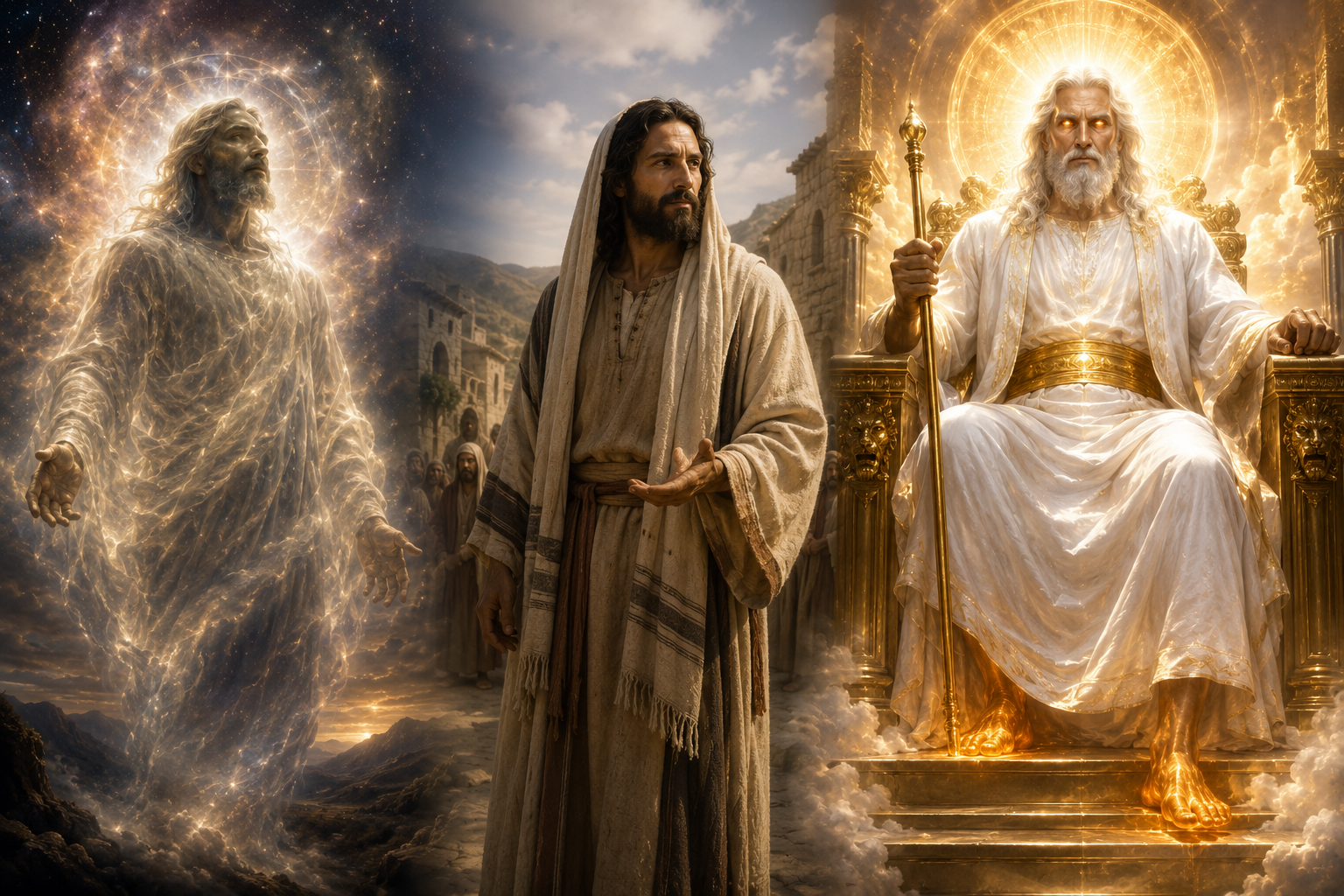
AI generated image.
In Part One of the Godship of Christ series, we defined the Godhead and examined the ancient nature of Jesus as YHWH Elohim. In Part Two, we will take a closer look at the manhood of Jesus, how His Godship was expressed during that phase of His existence, and what His humanity means for us.
One phrase often quoted in Trinitarian theology is this: “Jesus is 100% God and 100% man.” While we know that being born of a woman was not Jesus’ eternal nature, a common point of contention is whether the man Jesus was fully God while He walked the earth.
Though I hold to the Trinitarian view, I subscribe to some minor differences in how I understand Christ’s earthly life. In His ancient nature, YHWH is indeed a member of the Godhead. However, Scripture reveals that, while on earth, Jesus temporarily laid aside His position and privileges in the Godhead. In this sense, the man Jesus was 100% man on earth, without Godhead privileges that would make His human experience fundamentally unequal to ours.
This raises two important questions: How? And why?
How Did Jesus Become Fully Man?
We know that the man Jesus was born of a woman. We also know that this woman was a virgin who conceived by the power of the Holy Spirit (Luke 1:34–35). So wouldn’t that mean Jesus was still fully God while on earth, considering that His conception was supernatural?
Philippians 2:6–9 is a well-known passage that helps answer both the “how” and the “why.” Let us first examine verses 6–7:
6 Who, being in the form of God (YHWH Elohim), thought it not robbery to be equal with God: 7 But made himself of no reputation, and took upon him the form of a servant (the man Jesus), and was made in the likeness of men.
As demonstrated here, the ancient Spirit of Jesus—who was equal with God—took upon Himself the form of a servant and was made in the likeness of men. YHWH became fully man through His birth and through the temporary laying aside of His rank and position in the Godhead.
Hebrews 2:9 goes even deeper into this “how”:
9 But we see Jesus, who was made a little lower than the angels for the suffering of death, crowned with glory and honour.
Depending on your doctrinal background, you may rarely have heard emphasis placed on the statement that Jesus “was made a little lower than the angels.” Yet Scripture says exactly that.
How, then, can Jesus be described as both “fully God” and “a little lower than the angels”?
This leads us to the “why.”
Why Did Jesus Become Fully Man?
Let us continue with Philippians 2:8–9:
8 And being found in fashion as a man, he humbled himself, and became obedient unto death, even the death of the cross. 9 Wherefore God also hath highly exalted him, and given him a name which is above every name.
The answer to the “why” becomes clearer here. Jesus became 100% man in order to die a sinner’s death and, through His obedience, death, and resurrection, attain both a heavenly and earthly exaltation that would secure new promises for believers.
Hebrews 2:9–10 gives us another perspective:
That he by the grace of God should taste death for every man. 10 For it became him, for whom are all things, and by whom are all things, in bringing many sons unto glory, to make the captain of their salvation perfect through sufferings.
Here we see that, through becoming fully man, Jesus’ death and resurrection accomplished a perfect salvation and established a new office available to those who are saved through Him: sonship.
Jesus did not merely come to demonstrate who He was. He came to bring many sons unto glory.
Jesus, Our Example
Many believers tend to view Jesus as someone beyond our realm of relatability—as only the God who accomplished everything for us, rather than also seeing Him as our brother and the perfect example of sonship.
But what Jesus accomplished through His life, death, and resurrection was not merely a display of His Godship. He was also establishing a path through which we could participate in the spiritual inheritance and glory made available through Him.
Two things are clear in New Testament doctrine: first, Jesus—as both YHWH and the man Jesus—is the Son of God; second, through Jesus, we can also become sons of God.
But how?
We follow the pattern demonstrated in Christ.
In Romans 8:13–17, Paul gives us the fundamentals of what it means to possess eternal life and live as a son of God under the New Covenant:
13 For if ye live after the flesh, ye shall die: but if ye through the Spirit do mortify the deeds of the body, ye shall live. 14 For as many as are led by the Spirit of God, they are the sons of God. 15 For ye have not received the spirit of bondage again to fear; but ye have received the Spirit of adoption, whereby we cry, Abba, Father. 16 The Spirit itself beareth witness with our spirit, that we are the children of God: 17 And if children, then heirs; heirs of God, and joint-heirs with Christ; if so be that we suffer with him, that we may be also glorified together.
Two things stand out here in defining sonship.
First, sonship requires walking according to the Spirit rather than according to the flesh.
Second, our participation in the glory of Christ is connected to our participation in His suffering: “if so be that we suffer with him, that we may be also glorified together.”
This means that the pattern demonstrated in Jesus must also be manifested in us. Just as sin was condemned in the flesh and Jesus was raised to life by the power of the Holy Spirit and exalted to His heavenly throne, we must also put to death the deeds of the flesh so that we may live by the Spirit and experience the heavenly life made available to us in Christ.
Some will say, “But Jesus was perfect. Only He qualified to die and be raised from the dead.”
Yet Jesus’ sinlessness should not cause us to disconnect His earthly life from our own. His sinlessness was demonstrated through self-denial, obedience, and the power of the Holy Spirit. Hebrews 4:14–16 shows just how deeply Jesus identified with our human experience:
14 Seeing then that we have a great high priest, that is passed into the heavens, Jesus the Son of God, let us hold fast our profession. 15 For we have not an high priest which cannot be touched with the feeling of our infirmities; but was in all points tempted like as we are, yet without sin. 16 Let us therefore come boldly unto the throne of grace, that we may obtain mercy, and find grace to help in time of need.
Jesus experienced genuine temptation. He experienced the weakness and limitations associated with human existence. Yet He remained without sin.
That matters because Jesus is not merely the One who died for us; He is also the One whose life demonstrates how we are called to live.
The danger in denying Jesus as our example—or believing that His finished work leaves us with no corresponding life of obedience—is that it can blind believers to the path leading to their eternal inheritance.
Jesus did not simply die for you; Scripture also calls you to die with Him.
The same Holy Spirit who empowered Jesus throughout His earthly ministry, sustained Him in obedience, and raised Him from the dead is the Spirit given to believers. Therefore, the life of Christ is not merely something we admire from a distance. It is a life that is meant to be manifested in us through the Holy Spirit.
To be crucified with Christ is not merely an inner imagination or theological concept. It speaks to the death of the old life and the mortification of the flesh so that we may walk in newness of life through the Holy Spirit.
Through that Spirit, we are empowered to walk in holiness, bear fruit, and perform the good works for which we were saved.
This is eternal life: the life of Christ manifested in us.
Conclusion
The man Jesus possesses an ancient identity—YHWH—that precedes all of us. Yet He took upon Himself flesh like ours and entered fully into the human experience. In that flesh, He demonstrated the quickening and empowering work of the Holy Spirit that now lives in believers.
Through His life, death, and resurrection, Jesus has made His Spirit available to us so that we may live the life God the Father intended for us to live and inherit the promises prepared for those who believe in Him and walk according to the Spirit.
Jesus is not only our Savior.
Jesus is our example.
